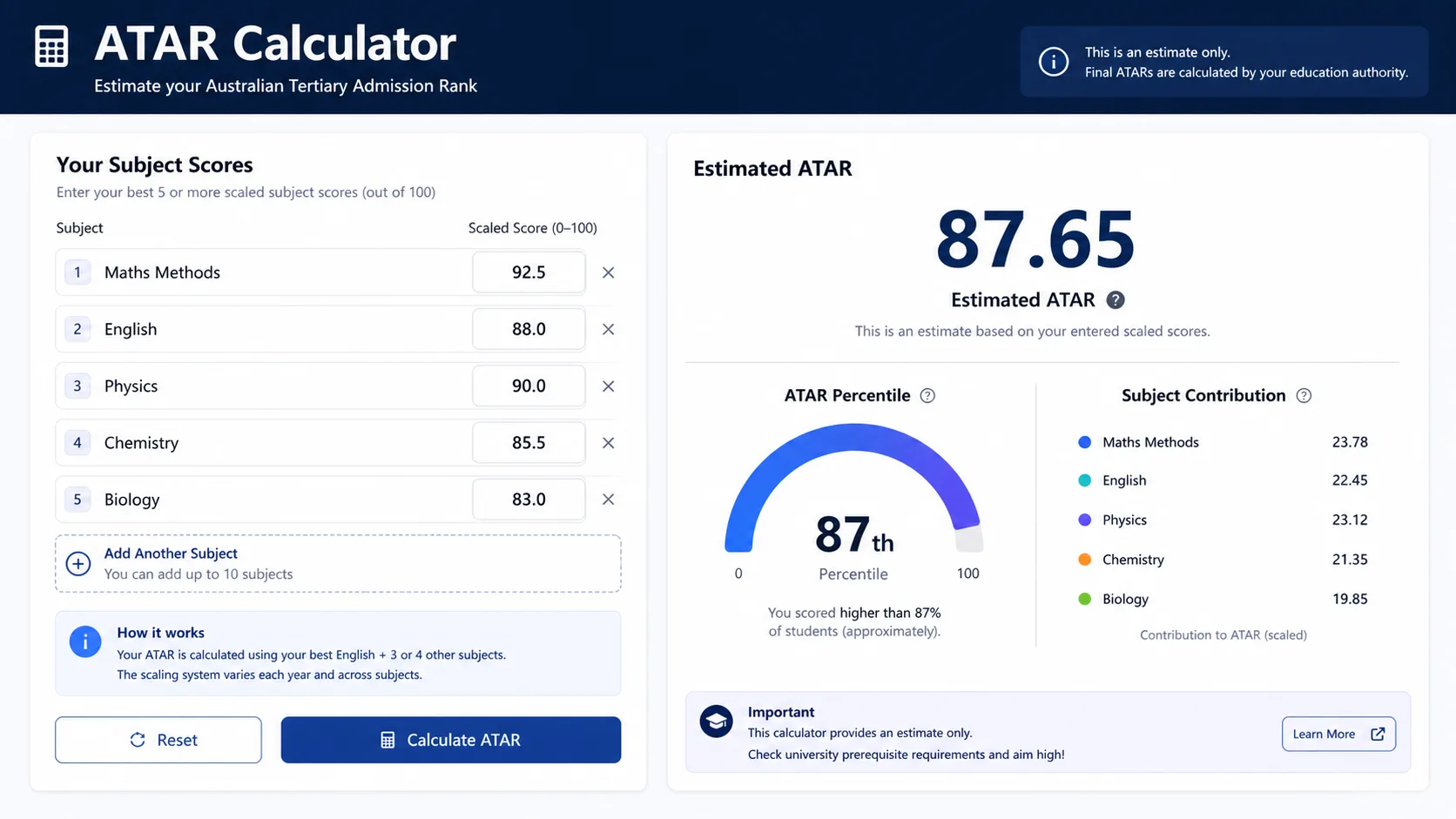
For many Australian students, the Australian Tertiary Admission Rank (ATAR) is one of the most important numbers in their academic journey. It plays a key role in determining university admissions and future career opportunities. Yet, despite its importance, the way ATAR is calculated often feels confusing and overwhelming.
This is where an ATAR calculator becomes incredibly useful. It helps simplify a complex system and gives you a clear estimate of where you stand academically. In this detailed guide, we’ll break down exactly how your ATAR is calculated step-by-step, explain the logic behind it, and show how calculators estimate your final rank.
What is ATAR and Why Does It Matter?
The ATAR is a percentile ranking between 0.00 and 99.95 that compares your performance to all other students in your cohort (usually within your state or territory).
For example:
● An ATAR of 90.00 means you performed better than 90% of students
● An ATAR of 60.00 means you outperformed 60% of students
It’s important to remember that ATAR is not a score out of 100, but rather a ranking system. Universities use it as a standardized way to compare applicants from different schools and educational backgrounds.
Why Students Use an ATAR Calculator
- What is ATAR and Why Does It Matter?
- Why Students Use an ATAR Calculator
- Step-by-Step: How Your ATAR is Calculated
- Step 1: Raw Scores (Your Starting Point)
- Step 2: Subject Scaling (Leveling the Playing Field)
- Step 3: Calculating Your Aggregate Score
- Step 4: Ranking All Students
- Step 5: Converting Rank to ATAR
- How an ATAR Calculator Estimates Your Rank
- Example of a Simplified ATAR Calculation
- Key Factors That Influence Your ATAR
- 1. Subject Selection
- 2. Consistency Across Subjects
- 3. Cohort Performance
- 4. Scaling Variations
An ATAR calculator is designed to give you an early prediction of your final rank. While it doesn’t replace official results, it provides valuable insights that can help you plan ahead.
Students typically use ATAR calculators to:
● Estimate their university eligibility
● Understand how subject performance affects outcomes
● Set realistic academic goals
● Adjust study strategies before final exams
Instead of waiting until the end of the year, you can make informed decisions in real time.
Step-by-Step: How Your ATAR is Calculated
Step 1: Raw Scores (Your Starting Point)
Your ATAR journey begins with your raw scores in each subject. These scores come from:
● School assessments
● Coursework
● Final exams
Each subject generates a final mark, usually out of 100. However, these raw marks are not used directly to calculate your ATAR.
Why? Because not all subjects are equal in terms of difficulty and competition.
Step 2: Subject Scaling (Leveling the Playing Field)
Subject scaling is one of the most important—and misunderstood—parts of the ATAR process.
Scaling adjusts your raw scores based on:
● The difficulty of the subject
● The overall performance of students in that subject
● The competitiveness of the cohort
For instance:
● Subjects like advanced mathematics or physics may scale up if performed well by high-achieving students
● Some subjects may scale down if the overall competition level is lower
The goal of scaling is fairness. It ensures that students are not disadvantaged or advantaged simply because of their subject choices.
Step 3: Calculating Your Aggregate Score
Once scaling is applied, your scaled scores are combined to form an aggregate.
The aggregate typically includes:
● Your best-performing subjects (usually top 4–5)
● A combination of compulsory and elective subjects (depending on your state)
For example:
● English (compulsory in most states)
● Your next best subjects based on scaled scores
These scores are added together to create your total aggregate. This number is critical because it determines your position relative to other students.
Step 4: Ranking All Students
After aggregates are calculated, all students are ranked from highest to lowest.
This step is what makes ATAR a relative ranking system. Your performance is not judged in isolation—it’s compared against everyone else in your cohort.
Key points to understand:
● Even a small difference in aggregate scores can significantly affect your rank
● Your ATAR depends not only on your results but also on how others perform
This competitive aspect is why ATAR can vary slightly each year.
Step 5: Converting Rank to ATAR
Once all students are ranked, the final step is converting that ranking into a percentile score—the ATAR.
For example:
● The top-ranked student receives 99.95
● Students in the middle range receive around 50
● Lower-ranked students receive lower ATAR values
This percentile system makes it easy for universities to compare applicants and set admission cut-offs.
How an ATAR Calculator Estimates Your Rank
An ATAR calculator works by replicating the above process in a simplified way.
It generally:
- Accepts your subject scores
- Applies estimated scaling factors
- Calculates a projected aggregate
- Maps that aggregate to a predicted ATAR range
Because it uses historical data and general scaling trends, it may not be perfectly accurate—but it’s often close enough to guide your decisions.
Read More : Grow a Garden Weather Event
Example of a Simplified ATAR Calculation
Let’s look at a basic example:
You receive the following scaled scores:
● Mathematics: 88
● English: 82
● Chemistry: 79
● Business Studies: 76
● Information Technology: 72
Your aggregate would be:
88 + 82 + 79 + 76 + 72 = 397
Based on previous trends, this aggregate might correspond to an ATAR in the high 80s or low 90s, depending on the competition that year.
Key Factors That Influence Your ATAR
1. Subject Selection
Choosing subjects that align with your strengths can improve your overall performance.
2. Consistency Across Subjects
A balanced score across multiple subjects often leads to a higher aggregate.
3. Cohort Performance
Your ATAR depends on how well others perform in the same year.
4. Scaling Variations
Scaling changes slightly every year based on subject performance trends.
Common ATAR Myths
Myth 1: ATAR is just your exam score
Reality: It’s a ranking, not a raw mark.
Myth 2: Hard subjects guarantee higher ATAR
Reality: High performance matters more than subject difficulty.
Myth 3: ATAR calculators are always exact
Reality: They provide estimates, not official results.
Tips to Maximize Your ATAR
● Focus on subjects where you can achieve high marks
● Practice consistently using past exam papers
● Stay organized and manage your time effectively
● Use an ATAR calculator to monitor your progress
● Seek help early when struggling with difficult topics
Final Thoughts
Understanding how your ATAR is calculated gives you a major advantage. Instead of feeling uncertain, you can approach your studies with a clear strategy and realistic expectations.
The process raw scores → scaling → aggregate → ranking → ATAR may seem complex, but tools like ATAR calculators make it far more accessible. They allow you to track your progress, test different scenarios, and stay motivated throughout your academic journey.
In the end, your ATAR is not just a number it’s a reflection of your effort, consistency, and preparation. By understanding how it works and using the right tools, you can take control of your future and move confidently toward your university goals.