If you want to grow a garden that produces armloads of vegetables, vibrant flowers, and fruit-laden trees season after season, there is one thing that matters more than sunlight, more than watering schedules, and more than the variety of seed you plant. It is the soil types beneath your feet. Understanding garden soil is the single highest-leverage decision any grower can make, and yet it remains the most overlooked step in gardening.
This 2026 complete guide breaks down every major soil type for growing a garden, explains exactly how to identify what you have, and gives you proven, science-backed methods to transform even the worst clay or sandy patch into a productive, living ecosystem. Whether you are starting your first raised bed, converting lawn into vegetable rows, or trying to rescue a struggling plot, you will find the answers here.
A single teaspoon of healthy garden soil contains more than one billion bacteria, tens of thousands of fungi species, and thousands of protozoa. Building the right soil structure is not just about nutrients; it is about engineering a living system that works for your plants 24 hours a day.
Why Soil Type Is the Foundation of Every Successful Garden
Most gardeners reach for fertilizers or pest sprays when their plants underperform. But yellowing leaves, stunted growth, poor fruit set, and persistent disease almost always trace back to a soil problem. Before you can fix anything above ground, you have to understand what is happening below it.
Soil is not just dirt. It is a dynamic mixture of mineral particles, organic matter, water, air, and billions of living organisms. The proportion and arrangement of these elements determines whether your tomatoes will weigh two pounds or two ounces. Specifically, ideal garden soil maintains roughly 40 percent mineral particles for structure, 25 percent air for oxygen delivery to roots, 25 percent water for hydration, and 10 percent organic matter that binds everything together and feeds the microbial workforce.
The physical texture of your soil, meaning the relative proportions of sand, silt, and clay particles, controls three critical functions:
- Drainage: How fast excess water moves through the profile
- Aeration: How much oxygen is available to plant roots and beneficial microbes
- Nutrient retention: How well the soil holds onto minerals before they leach away
Get all three right, and almost any vegetable or flower will thrive. Get one wrong, and you will fight your garden all season long. This is why knowing your garden soil type is the mandatory first step before any amendment, fertilizer, or planting plan.
The unseen majority of soil, its microbes, are the true drivers of plant diversity and productivity in terrestrial ecosystems. Without understanding the biological component of your soil, all surface-level gardening decisions are guesswork.
van der Heijden, M.G.A., Bardgett, R.D. & van Straalen, N.M., Annual Review of Microbiology (2016)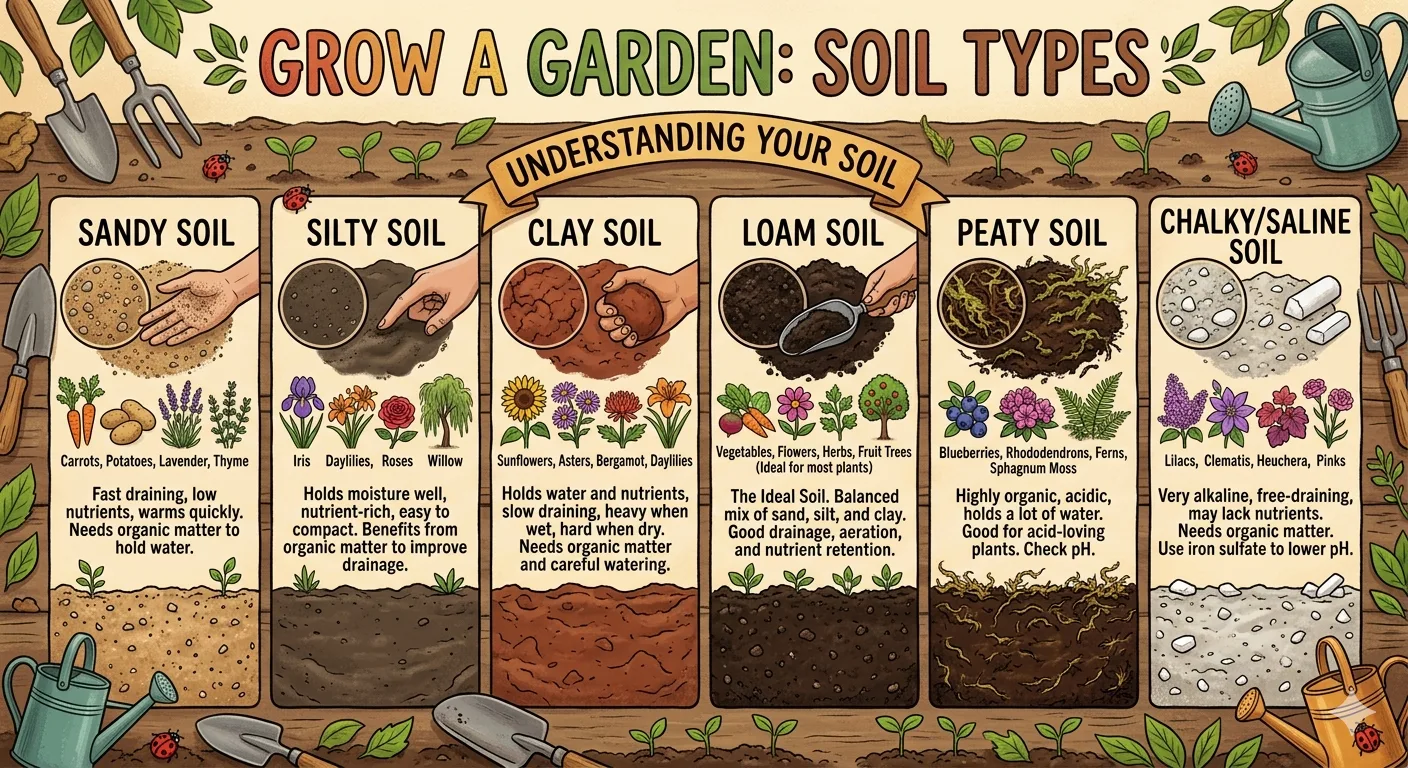
The 6 Main Soil Types for Growing a Garden (Fully Explained)
- Why Soil Type Is the Foundation of Every Successful Garden
- The 6 Main Soil Types for Growing a Garden (Fully Explained)
- Soil Type Performance Comparison Chart
- Deep Dive: Each Garden Soil Type Explained
- 1. Clay Soil: Rich but Challenging
- 2. Sandy Soil: Fast but Hungry
- 3. Loam Soil: The Gold Standard for Growing a Garden
- 4. Silt Soil: Smooth and Silky
- 5. Peaty Soil: Dark and Spongy
- 6. Chalky Soil: Alkaline and Shallow
- How to Identify Your Garden Soil Type: 4 Simple Tests
- Test 1: The Hand Squeeze Test
- Test 2: The Jar Sediment Test
- Test 3: The Drainage Test
- Test 4: The pH Test Kit
- The Living Soil: Understanding the Microbial Engine Beneath Your Garden
- How to Build a Thriving Soil Microbiome
- The Best Soil Mixes for Growing a Garden: By Garden Type
- In-Ground Vegetable Garden Soil Mix
- Raised Bed Soil Mix
- Container and Pot Soil Mix
- Seed Starting Mix
- Soil Amendment Guide: What to Add and When
- Organic Amendments (Add Annually)
- Mineral Amendments (As Needed, Based on Soil Test)
- Step-by-Step Soil Improvement Process
- Which Soil Type Is Best for Popular Garden Crops?
- Seasonal Soil Care Calendar for Growing a Garden
- Spring: Wake Up Your Soil
- Summer: Protect and Feed
- Autumn: The Most Productive Amendment Window
- Winter: Let the Soil Rest
- Advanced Techniques: Building Soil Faster in 2026
- No-Dig Gardening
- Korean Natural Farming (KNF) and Indigenous Microorganism (IMO) Inoculants
- Biochar Application
- Companion Planting for Soil Health
- Conclusion: Build the Soil, Grow the Garden
There are six primary soil types that gardeners encounter around the world. Each has unique strengths, weaknesses, and amendment strategies. Here is a quick-reference overview before we dive deep into each one.
Clay Soil
Dense, nutrient-rich, but prone to waterlogging and compaction. Warms slowly in spring.
Sandy Soil
Fast draining, easy to work, but loses nutrients and moisture rapidly. Warms fast.
Loam Soil
The gold standard. Balanced drainage, aeration, and nutrient retention. Most vegetables thrive in it.
Silt Soil
Smooth, moisture-retentive, moderately fertile. Can compact under heavy rain or foot traffic.
Peaty Soil
High in organic matter, dark, spongy. Retains water well but can be too acidic for most crops.
Chalky Soil
Alkaline, free-draining, often shallow. Can lock up key nutrients like iron and manganese.
Soil Type Performance Comparison Chart
| Soil Type | Drainage | Nutrient Retention | Workability | Typical pH | Best For |
|---|---|---|---|---|---|
| Clay | Poor | High | Difficult | 6.0 – 7.0 | Brassicas, shrubs |
| Sandy | Excellent | Low | Easy | 5.5 – 7.0 | Root vegetables, carrots |
| Loam | Good | High | Easy | 6.0 – 7.0 | All vegetables, most plants |
| Silt | Moderate | Moderate | Moderate | 6.0 – 7.0 | Leafy greens, corn |
| Peaty | Poor | Moderate | Moderate | 3.5 – 5.5 | Blueberries, heathers |
| Chalky | Good | Low | Moderate | 7.5 – 8.5 | Lavender, spinach |
Deep Dive: Each Garden Soil Type Explained
1. Clay Soil: Rich but Challenging
Clay soil is made up of the smallest mineral particles, less than 0.002 mm in diameter. These tiny particles pack tightly together, creating a dense, sticky mass when wet and a hard, cracked surface when dry. Despite its reputation, clay soil is actually very nutrient-rich because those same tiny particles carry strong negative electrical charges that attract and hold positively charged nutrient ions like calcium, magnesium, and potassium.
The key challenge is poor drainage and aeration. Roots sitting in waterlogged clay starve for oxygen, and beneficial soil organisms suffocate. Clay also warms slowly in spring, delaying planting windows by two to three weeks compared to loam.
How to identify clay soil: Take a handful of moist soil and squeeze it. Clay will form a smooth, sticky ball that holds its shape well and feels slippery when rubbed between fingers.
Best plants for clay soil (unamended): Brassicas (cabbage, broccoli), dahlias, asters, rudbeckia, and many fruit trees including apple and pear.
How to Improve Clay Soil
- Add 2 to 4 inches of compost and work it into the top 12 inches each season
- Incorporate coarse horticultural grit or pea gravel to open up pore spaces
- Plant cover crops like crimson clover or winter rye; their roots physically break up compaction
- Avoid walking on clay when wet to prevent compaction
- Raised beds filled with a custom loam mix offer the fastest bypass for severe clay
2. Sandy Soil: Fast but Hungry
Sandy soil consists of large, irregular particles (0.05 to 2 mm) with wide gaps between them. Water drains through almost instantly, which means it is virtually impossible to waterlog, warms up fast in spring, and is extremely easy to dig and work. Root vegetables like carrots and parsnips grow beautifully straight in sandy soil because there is no resistance.
The downside is that those same large gaps allow nutrients and moisture to leach away rapidly. Sandy soil also has very low organic matter content naturally, which means the microbial community that plants depend on is sparse. You may find yourself watering and feeding far more frequently than gardeners on heavier soils.
How to identify sandy soil: Moist sandy soil squeezed in the hand will fall apart immediately and feels distinctly gritty, like fine sandpaper.
How to Improve Sandy Soil
- Apply generous compost: 3 to 4 inches annually, every spring and fall
- Use worm castings to dramatically increase nutrient-holding capacity
- Mulch thickly (3 to 4 inches) with straw or wood chips to reduce moisture evaporation
- Consider biochar: a research-proven amendment that permanently increases moisture and nutrient retention in sandy profiles
- Plant nitrogen-fixing cover crops like hairy vetch between seasons
3. Loam Soil: The Gold Standard for Growing a Garden
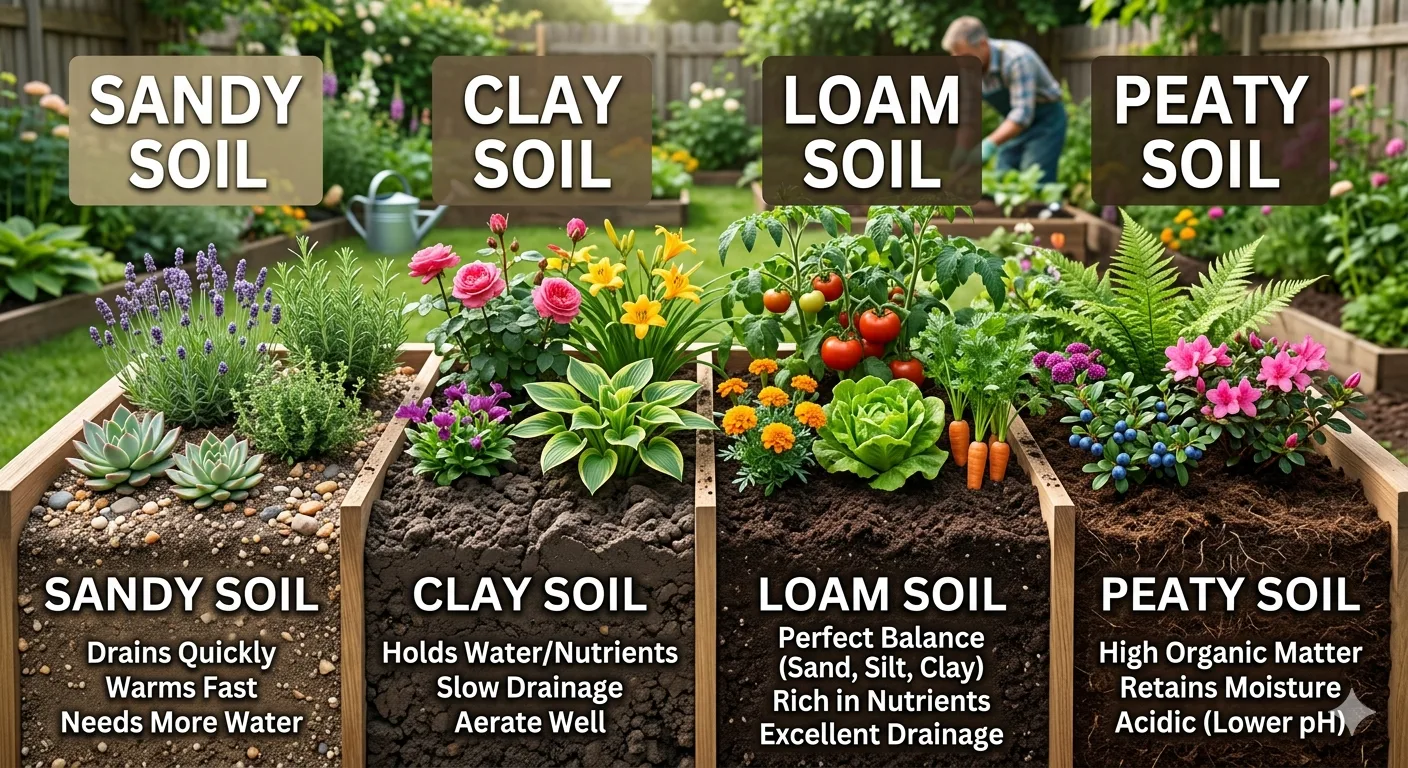
Loam soil is the target that every gardener is working toward. A classic loam contains roughly 40 percent sand, 40 percent silt, and 20 percent clay, creating a texture that balances drainage, aeration, and nutrient retention perfectly. It drains well after rain but retains enough moisture between irrigations. It has a loose, crumbly structure that roots penetrate effortlessly. It is rich in organic matter and teems with beneficial organisms.
Loamy soil holds together when squeezed but crumbles apart under gentle pressure. It has a rich, earthy aroma that signals a thriving microbial population. Research published in Nature Communications (2025) found that loamy soils show the highest ecosystem multifunctionality scores across European agricultural sites, confirming what growers have known for generations.
Maintaining Loam Soil
- Add 1 to 2 inches of compost every spring as a maintenance layer
- Minimize tilling to protect fungal networks and existing soil structure
- Rotate crops to prevent nutrient depletion from repeat plantings
- Test pH annually; loam can drift over time with heavy watering or acidic mulches
4. Silt Soil: Smooth and Silky
Silt soil is composed of medium-sized particles (0.002 to 0.05 mm) that feel smooth and floury when dry and silky when damp. It sits between sand and clay in most properties: better drainage than clay, better water retention than sand, and moderate nutrient-holding ability. Silt is often found in river valleys and flood plains, which is why alluvial farmland is historically among the most productive in the world.
The main challenge is that silt particles can compact easily under rainfall or foot traffic, forming a surface crust that repels water and limits gas exchange. It is also more susceptible to erosion than other soil types.
How to Improve Silt Soil
- Avoid heavy foot traffic; use permanent paths between beds
- Add compost and aged manure to improve structural stability
- Mulch to reduce surface crust formation after rain
- Consider raised beds in areas prone to flooding or compaction
5. Peaty Soil: Dark and Spongy
Peaty soil is formed from partially decomposed organic matter accumulated over thousands of years in waterlogged conditions. It is dark brown to almost black, spongy to the touch, and extremely high in organic content, sometimes 30 to 40 percent by weight. It holds water exceptionally well, which is both an advantage in dry climates and a challenge in wetter ones.
The major limitation is pH: peaty soils are typically quite acidic, ranging from 3.5 to 5.5. At this pH, many essential nutrients become chemically locked and unavailable to plants. Most standard vegetables struggle badly in unmodified peaty soil.
Best Uses and Amendments for Peaty Soil
- Ideal unamended: Blueberries, cranberries, rhododendrons, heathers, and azaleas all love acidic peaty conditions
- For general vegetables: add agricultural lime to raise pH toward 6.0 to 6.5
- Improve drainage by incorporating coarse sand and grit
- Add balanced fertilizers since peaty soil can be nutrient-poor despite high organic content
6. Chalky Soil: Alkaline and Shallow
Chalky soil forms over limestone or chalk bedrock and is naturally very alkaline, often reaching pH 7.5 to 8.5. It is usually shallow, free-draining to the point of being droughty, and contains visible pale stones or chalk fragments. The high pH causes iron and manganese chlorosis, a yellowing of leaves where the veins remain green, because these micronutrients become chemically unavailable above pH 7.5.
Chalky soils warm quickly in spring, which gives an early start advantage, and lavender, lilac, honeysuckle, and many herbs perform beautifully in them without amendment.
How to Improve Chalky Soil
- Apply heavy organic matter to improve moisture retention and gradually moderate pH
- Use acidic amendments like sulfur or acidic mulches (pine bark, leaf mold) to inch pH down
- Apply chelated iron and manganese foliar feeds to bypass pH lockout
- Deep raised beds allow you to grow acid-preferring crops above the chalky native layer
How to Identify Your Garden Soil Type: 4 Simple Tests
Before spending a single dollar on amendments, you need to know exactly what soil type you are working with. Here are four reliable at-home tests any gardener can perform.
Test 1: The Hand Squeeze Test
Take a handful of moist (not wet) soil from about 6 inches below the surface. Squeeze it firmly in your closed fist, then open your hand and observe:
- Stays in a smooth, sticky ball = Clay
- Falls apart immediately, feels gritty = Sandy
- Holds shape but crumbles with gentle pressure = Loam
- Forms a ball and feels silky = Silt
- Spongy and dark, holds water = Peaty
- Gritty with pale stones visible = Chalky
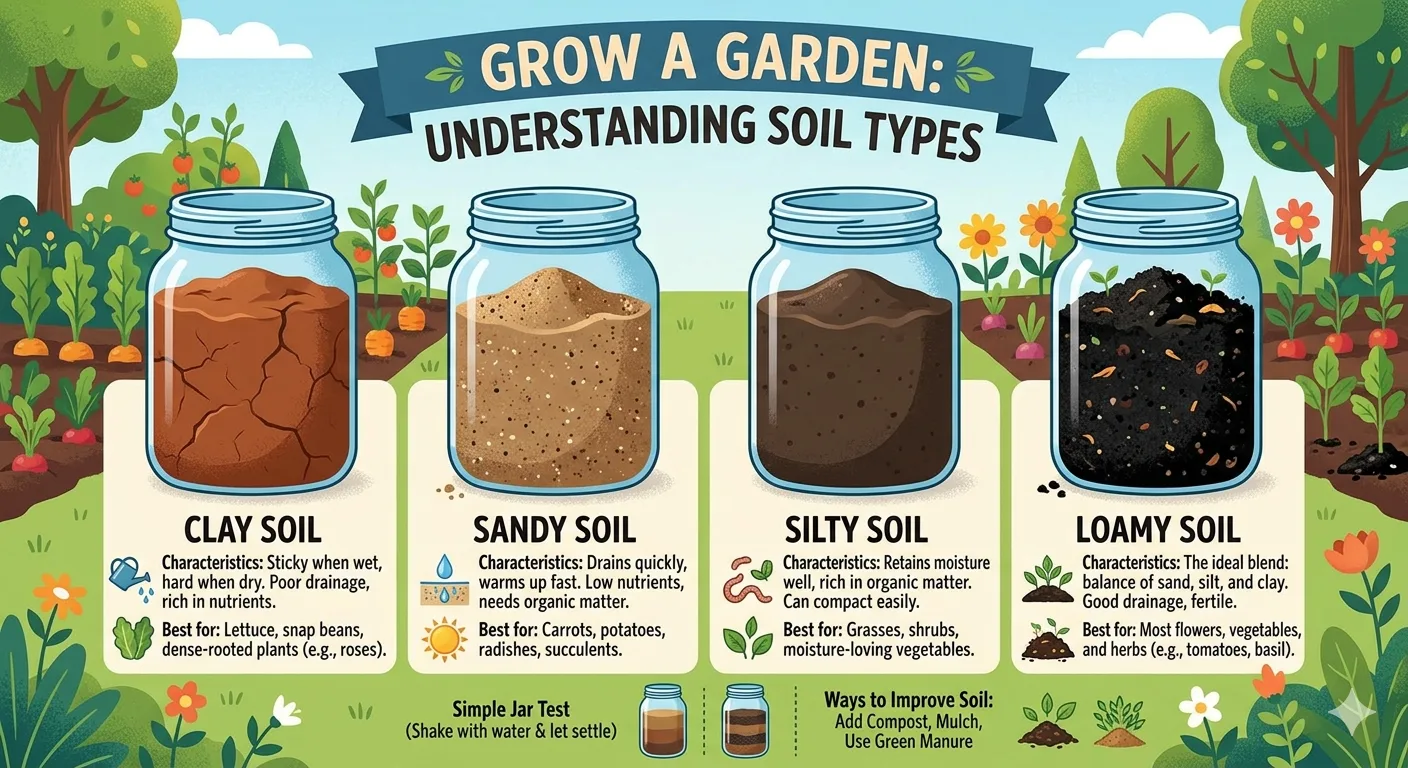
Test 2: The Jar Sediment Test
Fill a large glass jar one-third with soil and top up with water. Add a drop of dish soap, seal the jar, shake vigorously, and let it settle for 24 to 48 hours. Sand will settle to the bottom first (within minutes), silt will form the middle layer (settling in a few hours), and clay will remain suspended or settle as the top layer last. Measure each layer to calculate your soil's approximate texture composition.
Test 3: The Drainage Test
Dig a hole 12 inches deep and 12 inches wide. Fill it with water and let it drain completely. Fill it again and time how long the second fill takes to drain. Good drainage: water drains in 1 to 3 hours. Poor drainage (likely clay): water remains for 4 or more hours. Too fast (likely sandy): drains in under 20 minutes.
Test 4: The pH Test Kit
A simple at-home pH test kit (available from any garden center for under $15) will tell you your soil's acidity or alkalinity. This single number controls which nutrients your plants can actually access. Test from multiple spots 6 inches deep and average the results.
Soil pH Scale and Vegetable Sweet Spot
Most vegetables grow best between pH 6.0 and 7.0. Blueberries prefer 4.5–5.5. Lavender and brassicas tolerate up to 7.5.
The Living Soil: Understanding the Microbial Engine Beneath Your Garden
One of the most overlooked aspects of growing a garden is the biological dimension of soil. The microbes in your soil, including bacteria, fungi, protozoa, nematodes, and earthworms, are not passive bystanders. They are the engine that converts organic matter into plant-available nutrients, suppresses disease, builds soil aggregates, and determines the long-term fertility trajectory of your garden.
Soil microbiomes present a promising avenue for sustainable agriculture, offering the potential to increase crop yields, enhance nutrient use efficiency, bolster plant resistance to environmental stresses, and improve overall plant health.
Springer Nature, Discover Agriculture Journal (April 2025)A 2025 study published in Nature Communications analyzing 484 soils across 27 European countries found that microbial biomass and nitrogen content are the strongest predictors of soil productivity, accounting for 12 to 31 percent of variation in ecosystem multifunctionality. This means feeding your soil biology is as important as feeding the plants themselves.
How to Build a Thriving Soil Microbiome
- Add diverse organic matter: Compost, aged manure, leaf mold, straw, and wood chips each feed different microbial communities
- Reduce tillage: Every deep tillage operation severs fungal hyphal networks that can take years to rebuild
- Avoid synthetic pesticides and herbicides: Research in Nature Communications (2025) demonstrated negative effects on plant-beneficial bacteria from pesticide exposure across nearly 2,000 soil samples
- Plant cover crops: Roots constantly shed exudates that feed specific microbial populations; more root diversity means more microbial diversity
- Keep soil covered: Bare soil dries out, overheats, and loses microbial mass rapidly
The Best Soil Mixes for Growing a Garden: By Garden Type
In-Ground Vegetable Garden Soil Mix
For an in-ground garden on native soil, the goal is to amend rather than replace. Start by working 3 to 4 inches of high-quality compost into the top 12 inches of your existing soil. This single step improves drainage in clay, increases water retention in sand, and supercharges biological activity in any soil type.
Recommended annual additions:
- 2 to 3 inches of finished compost (spring and fall)
- Balanced organic fertilizer worked into the top 4 inches at planting
- 2 to 3 inches of straw or leaf mulch as a surface cover
Raised Bed Soil Mix
Raised beds give you the freedom to build a custom growing medium from scratch. The most proven formula is Mel's Mix: one-third compost, one-third peat moss or coconut coir, and one-third coarse vermiculite. Research trials have shown this blend yields 7 lbs of tomatoes per plant compared to 5.3 lbs from a standard topsoil-compost blend.
An alternative high-performance raised bed recipe:
- 50% quality topsoil or loam
- 30 to 35% mature compost
- 15 to 20% perlite or coarse horticultural grit
- Optional: 5% worm castings for supercharged biological activity
Never use standard bagged garden soil in containers or raised beds. It compacts under the weight of watering, suffocates roots, and drains poorly once confined.
Container and Pot Soil Mix
Containers require potting mix, not garden soil. A quality potting mix is formulated to remain loose and well-aerated despite being confined and repeatedly watered. Key components include peat moss or coir, perlite, bark chips, and slow-release fertilizer. Ideally, replace or refresh potting mix annually, as the structure degrades after one season.
Seed Starting Mix
For germinating seeds indoors, use a soilless seed-starting mix. These are ultra-fine blends of peat, vermiculite, and perlite with no organic matter that could harbor pathogens and damage fragile seedlings. Never use outdoor garden soil for seed starting.
Read More : Grow a Garden Market Trends
Soil Amendment Guide: What to Add and When
Once you know your soil type and have tested your pH, you can choose targeted amendments that will make the biggest difference in a single season.
Organic Amendments (Add Annually)
- Compost: Universal improver for all soil types. Increases organic matter, feeds microbes, improves structure. Apply 1 to 3 inches per year.
- Aged manure (cow, horse, chicken): High in nitrogen, phosphorus, and potassium. Always use well-aged or composted manure to avoid burning plants or introducing pathogens.
- Worm castings: The most biologically active amendment available. Rich in enzymes, beneficial bacteria, and plant-available nutrients. Ideal as a seed-row amendment.
- Leaf mold: Decomposed autumn leaves create a fine-textured humus that improves soil structure and moisture retention with minimal nutrient input.
- Green manures and cover crops: Crimson clover, buckwheat, and winter rye add nitrogen, organic matter, and biological diversity when turned in or cut and left as mulch.
Mineral Amendments (As Needed, Based on Soil Test)
- Garden lime (calcium carbonate): Raises pH in acid soils. Apply in fall for best results. Start with 5 lbs per 100 sq ft; retest after 6 months.
- Sulfur: Lowers pH in alkaline or chalky soils. Slow-acting; apply 6 months before planting if possible.
- Gypsum (calcium sulfate): Improves clay structure without affecting pH. One of the best clay-busting tools available.
- Coarse grit or perlite: Physically improves drainage and aeration in clay or compacted soils.
- Biochar: A charred organic material that permanently improves nutrient and water retention, especially in sandy soils. Growing evidence from sustainable agriculture research supports its long-term benefits.
Step-by-Step Soil Improvement Process
-
Test first. Use a home pH and NPK test kit on multiple samples before spending any money on amendments.
-
Identify your texture. Perform the hand squeeze and jar test to confirm your primary soil type.
-
Address pH first. If pH is outside the 6.0 to 7.0 range for vegetables, amend with lime (too acid) or sulfur (too alkaline) and wait 4 to 6 weeks before adding other amendments.
-
Add compost. Regardless of soil type, 2 to 4 inches of compost worked into the top 12 inches is the single most impactful step you can take.
-
Target your specific soil type. Clay: add gypsum and grit. Sandy: add worm castings and extra organic matter. Silt: add compost and avoid compaction.
-
Mulch the surface. A 2 to 3 inch mulch layer is the best investment you can make in your soil biology and moisture retention.
-
Retest annually. Soil is a living system that changes. Annual testing lets you correct drift before it costs you a harvest.
Which Soil Type Is Best for Popular Garden Crops?
| Crop | Preferred Soil Type | Ideal pH | Key Nutrient Need |
|---|---|---|---|
| Tomatoes | Loam or amended clay | 6.0 – 6.8 | Calcium, potassium |
| Carrots | Sandy loam or light silt | 6.0 – 7.0 | Phosphorus |
| Lettuce | Loam, silt, or raised bed mix | 6.0 – 7.0 | Nitrogen |
| Potatoes | Sandy loam, slightly acid | 5.0 – 6.0 | Potassium |
| Beans | Loam or sandy loam | 6.0 – 7.5 | Nitrogen (self-fixing) |
| Brassicas | Clay loam or loam | 6.5 – 7.5 | Nitrogen, calcium |
| Blueberries | Peaty or acidic sandy | 4.5 – 5.5 | Iron, manganese |
| Cucumbers | Sandy loam or raised mix | 6.0 – 7.0 | Potassium |
| Onions/Garlic | Sandy loam or loam | 6.0 – 7.0 | Sulfur, phosphorus |
| Sweet corn | Loam or silt loam | 5.8 – 7.0 | Nitrogen |
Seasonal Soil Care Calendar for Growing a Garden
Spring: Wake Up Your Soil
As temperatures rise above 50°F (10°C), soil microbial activity begins to accelerate. This is the time to apply compost as a 1 to 2 inch topdressing without digging it in. Let earthworms and rain incorporate it naturally. Test soil pH before planting and correct if necessary. For clay soils, avoid working the ground when still wet; wait until a handful crumbles rather than smears.
Summer: Protect and Feed
Summer heat can rapidly deplete soil moisture and biological activity. A 3 inch mulch layer in summer is worth more than any fertilizer application because it reduces soil temperature by up to 10°F, cuts evaporation by 50 to 70 percent, and feeds the surface-dwelling microbial community. Side-dress heavy feeders like corn and tomatoes with compost tea or balanced organic fertilizer mid-season.
Autumn: The Most Productive Amendment Window
Autumn is the single best time to make major soil amendments because organic matter has the entire winter to break down and integrate before spring planting. Apply compost, aged manure, and any lime or sulfur needed for pH correction. Plant cover crops in empty beds to protect soil through winter and add organic matter come spring.
Winter: Let the Soil Rest
In most climates, winter is a time of soil recovery. Freeze-thaw cycles naturally break up compacted aggregates, particularly in clay soils. Cover crops protect against erosion and continue feeding microbial communities. Avoid digging or disturbing soil when frozen.

Advanced Techniques: Building Soil Faster in 2026
No-Dig Gardening
The no-dig method, popularized by Charles Dowding, involves layering organic matter on top of existing soil without ever tilling. This preserves the delicate fungal networks and soil aggregates that tillage destroys. Studies confirm that no-dig gardens develop superior structure and biological activity within two to three years and often outperform heavily tilled beds in long-term productivity.
Korean Natural Farming (KNF) and Indigenous Microorganism (IMO) Inoculants
Korean Natural Farming uses locally sourced wild yeasts, bacteria, and fungi collected from forest floors to inoculate garden soil. These indigenous microorganism cultures dramatically accelerate organic matter decomposition and nutrient cycling. In 2025, multiple studies confirmed that diversifying soil microbial inputs leads to measurable yield improvements in vegetable production.
Biochar Application
Biochar is a form of charcoal produced from organic material through a process called pyrolysis. When incorporated into garden soil at rates of 5 to 10 percent by volume, it permanently improves nutrient retention, water-holding capacity, and microbial habitat. Recent research from sustainable agriculture journals shows biochar contributes positively to soil organic carbon content and long-term water retention, making it especially valuable for sandy soils in drought-prone climates.
Companion Planting for Soil Health
Certain plant combinations actively improve soil as they grow. Legumes (peas, beans, clover) fix atmospheric nitrogen through their root symbioses with Rhizobium bacteria, effectively fertilizing neighboring plants. Deep-rooted plants like comfrey and daikon radish mine subsoil nutrients and bring them to the surface when their leaves die back as mulch.
A 1 percent increase in organic matter helps soil hold approximately 20,000 additional gallons of water per acre. The practical target for any vegetable garden is achieving 5 percent or higher organic matter content.
GardenGlove Research Compilation, citing USDA Natural Resources Conservation Service dataConclusion: Build the Soil, Grow the Garden
Every great garden begins beneath the surface. Whether you are working with sticky clay, hungry sand, perfect loam, or anything in between, the path to a productive, beautiful garden is the same: understand your soil type, test what you have, and build systematically from there.
The six soil types covered in this guide each have real strengths that can be leveraged and real weaknesses that can be corrected. No starting point is hopeless. Clay becomes incredibly productive once its drainage is improved. Sandy soil, loaded with compost and mulched consistently, can sustain some of the most vigorous vegetable growth you will ever see. Even chalk and peat can be tamed or bypassed with raised beds.
The most important action you can take today is to test your soil, identify your type, and add compost. That single habit, repeated season after season, compounds into extraordinary garden fertility. Add to it by reducing tillage, planting cover crops, and building your soil's microbial community, and you will be growing a garden that performs better every single year.
Also Checkout :